
Installations — Jacopo Dotti
Jacopo Dotti's installations combine sound art, site-specific works, and video mapping, in a research project that explores the relationship between sound, architectural space, and visitor perception.
Each installation stems from a study of its host location: the work isn't placed in space, it's constructed from the space itself—from its proportions, its acoustics, its history. A journey that combines musical training as a multi-instrumentalist, architectural research at IUAV, and contemporary artistic practice.
Research topics
Sound Art and Sound Installation
At the heart of Jacopo Dotti's installation research is sound art: works in which sound is sculptural material, not accompaniment. Music constructs the installation as much as the objects within it, in an experience that simultaneously engages sight, hearing, and the body's movement in space.
A work rooted in the tradition of international sound art and reinterpreted with the sensitivity of a multi-instrumentalist.
Site-specific and dialogue with architecture
Site-specific installations cannot be reproduced elsewhere: they originate, live, and last in the space for which they were conceived. Jacopo Dotti develops this practice with particular attention to the acoustics of the space, its historical memory, and the flow of visitors.
A staircase is not just an architectural element but becomes an instrument; a stairwell becomes a sounding board; a historic gallery becomes a score to be performed.
Video mapping and technological installations
Alongside acoustic installations, the research extends to video mapping and technological installations: architectural projections, immersive environments, and interactive works that combine image, sound, and programming. This field engages with the video practice and multimedia creative direction of Revolux Studios.
The work-visitor relationship
Every installation by Jacopo Dotti presupposes an active visitor: those who enter the work become part of it. The footsteps that reverberate in Euterpe, the movement of the body in the gallery space, the time the visitor chooses to dedicate to the experience—all contribute to completing the work's meaning.
The work-visitor relationship
Euterpe — Cesare Pollini Conservatory, Padua (2015)
Sound installation presented at the "Nuovi Segnali" exhibition, curated by Guido Bartorelli (University of Padua). The work is located in the building's stairwell, echoing its meaning: an acoustic resonance chamber that reverberates with the footsteps of those ascending, metaphorically comparable to the path of knowledge. The Muse Euterpe—a source of musical inspiration—stands before the plaque commemorating Cesare Pollini and his creative spirit. A work that synthesizes sound art, philosophical reflection, and site-specificity.
Installation and Performance — Royal Opera Arcade Gallery, London (2015)
Experimental music installation and performance as part of the exhibition "Inside III – Expo Contemporary Art" at the ROA – Royal Opera Arcade Gallery, designed by John Nash and active since 1821. Curated by Rosi Raneri and Elizabeth Mitchell D'Anna.
Installation and Performance — Flu Games Berlin II, Malzfabrik (2016)
Installation and performance coinciding with the 2016 Berlinale, at Berlin's historic Malzfabrik. Curated by Elena Jelmoni (Jelmoni Studio Gallery), with publication in the catalog published by Edizioni Pulcino Elefante.
Installation and Performance — Sale del Bramante, Rome (2016)
Work and performance as part of the 11th International Exhibition of Contemporary Art "EXPO/EGOS XI", curated by Rosi Raneri, at the Sale del Bramante in Piazza del Popolo.
Sound research and video mapping
In addition to artistic installations displayed in exhibitions and galleries, Jacopo Dotti develops live sound, sound environments for installations, and architectural video mapping for events, performances, and cultural communication. This professional field, developed with Revolux Studios, combines expertise in sound design, programming, projection, and technical direction.
Jacopo Dotti - Euterpe - (Musa)


Author: Jacopo Dottti
Dimensions: 170 x 150 x 75 cm
Type: installation sculpture
Material: fiberglass, fabric (jersey), nylon
Technique: industrial production
Year: 2015
Location: Revolux Studios Collection
The work in question draws inspiration and reference first and foremost from a dreamlike vision of music, which is mythologically transfigured into the goddess Euterpe, the name of the work itself, and secondly, from the concept of revelation, of aletheia, one of the summa concepts of Martin Heidegger's thought. A celestial vision, at once ephemeral and profoundly intoxicating, sensual, like the music itself, which transforms into a floating Venus, in a horizontal position, supine and reaching, like the physical propagation of sound, towards infinity.
The goddess detaches herself from earthly immanence to attain knowledge, through a process of epistemology, transcendental ascension, revelation, and aletheia. It is the lifting of the very veil of Maya that makes reality real, not as ducks, but as it is. She symbolically reaches toward the light, toward enlightenment, toward the empyrean, through a Platonic Hyperuranion, from which, metaphysically, creation draws its vital source, the ability that brings humanity closest to God, and therefore to the creatio Ex Nili.
The artistic, historiographical, and morphological references to which the work refers are translated and consolidated in the scenography and content. From Antonio Canova's Cupid and Psyche, to Gian Lorenzo Bernini's Rape of Proserpina, the Ecstasy of Saint Teresa, and Blessed Ludovica Albertoni, from Antonio da Correggio's Assumption of the Virgin, through Giorgio de Chirico's Muses and Mannequins, and finally to the work of Maurizio Cattelan.
Euterpe, as depicted in various iconographies, holds a flute in her hand, imbued with sensual and instrumental meaning, of creation and procreation. Simultaneously a source of life and an instrument of gestation, a primordial and ancestral genesis, a new birth, a new life, like the music created and composed with the same instrument, like the Muse, who inspires the artist to create something new.
The viewer is plunged into a dimension of complete ecstatic rapture, inducing a contemplative and simultaneously soothing detachment of the soul, savored as never before in listening to music. Reflection, the detachment from materialism, leads the viewer to a symbolic and spiritual elevation of art and soul, immersed in a process of self-knowledge and introspective self-analysis, which finds inspiration in the fleeting and instantaneous nature of sensory and emotional perception, and which culminates in the ultimate perception of the innate pleasure of observing and listening.
The work, consistent with its meaning, finds its perfect dimension and placement within the exhibition, in the space and physical environment of the building's stairwell, which echoes its meaning. Almost like an acoustic sounding board, the footsteps of those preparing to climb the stairs resonate and reverberate, metaphorically comparable to the steep and complex path of knowledge leading to enlightenment.
The resulting semantics finds concrete expression in the ascending thrust comparable to the artist's aura and generative impulse, which drives one to create. The Muse, in fact, is a source of inspiration and revelation, like music, which draws inspiration and asserts itself as essence, before the plaque commemorating Cesare Pollini and his immortal creative and inspiring spirit. It is only music, sound, and vibrations that allow us to invade space and discover not its limits, but its infinity and immortality in the form of art, in its most perfect and alchemical quest for knowledge and experience.
Jacopo Dotti - Behind Blue Eyes

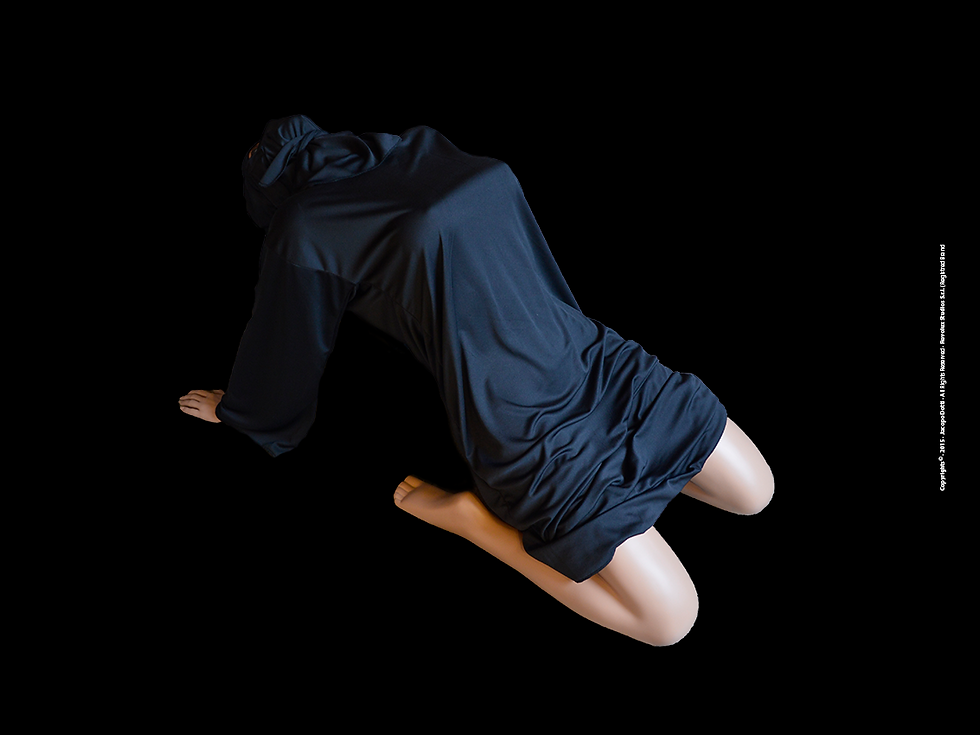

Author: Jacopo Dotti
Dimensions: 115 x 65 x 50 cm
Type: installation sculpture
Material: Fiberglass, Fabric (Clothes)
Technique: industrial production
Year: 2016
Location: Revolux Studios Collection
Jacopo Dotti - A Brick Out the Wall

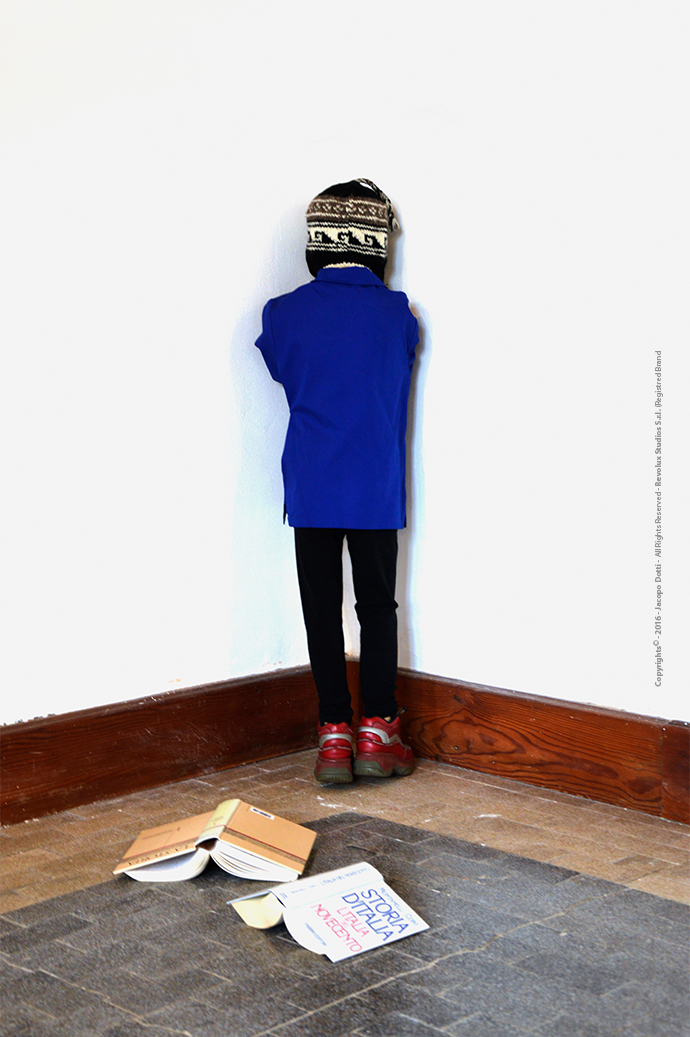

Author: Jacopo Dotti
Dimensions: 40 x 30 x 120 cm
Type: installation, sculpture
Material: Fiberglass, Fabric (Clothes)
Technique: industrial production
Year: 2016
Location: Revolux Studios Collection
